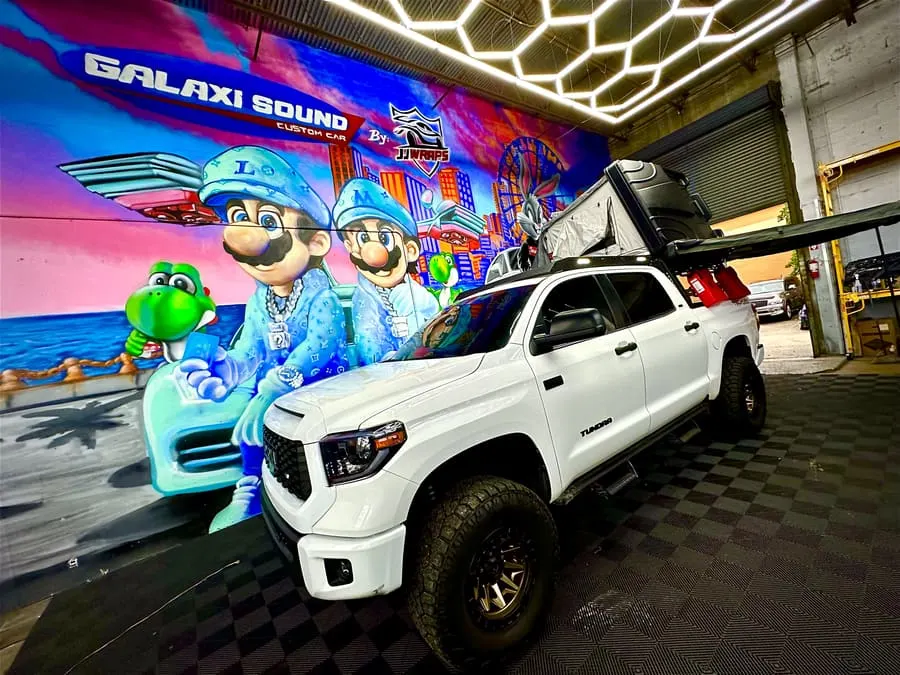
The short answer: in Miami, legal tint starts at 28% VLT on your front windows — and SUV and truck owners get significantly more flexibility in the back. But those two numbers are only the beginning, and getting it wrong means a fix-it ticket, a fine, and an expensive re-tint.
At Galaxi Sound, we've been installing window tint in Kendall and across Miami-Dade for over 30 years. Every one of our installs is measured before you leave the shop. This guide gives you the same straight talk our customers get in person — before anything goes on the glass.
Florida VLT standards: the numbers that matter
VLT (Visible Light Transmission) is the percentage of visible light that passes through your window film and glass combined. Lower percentage = darker tint. A 5% tint is near-black. A 70% tint is barely visible.
Florida law on window tint is governed by Florida Statutes §316.2953 (front side windows) and §316.2954 (windows behind the driver).
| Window | Sedan / Coupe | SUV / Van / Truck |
|---|---|---|
| Windshield | Non-reflective strip above AS-1 line only | Same |
| Front Side Windows | 28% VLT minimum | 28% VLT minimum |
| Back Side Windows | 15% VLT minimum | 6% VLT minimum |
| Rear Window | 15% VLT minimum | 6% VLT minimum |
| Max Reflectivity | 25% front side, 35% rear | 25% front side, 35% rear |
Other requirements you need to know:
- Certification sticker: Must be placed in the driver's-side door jamb on every legally tinted vehicle. Any professional shop should provide this automatically.
- Dual side mirrors: Required by law if your rear window is tinted at any level.
- Colors banned: Red and amber tints are prohibited in Florida.
- Mirrored/chrome tint: Illegal regardless of VLT — even if the light transmission number is compliant.
Miami-Dade specific rules
Miami-Dade County does not add local window tint rules on top of state law. Florida Statute §316.2953 preempts local regulation statewide. Whether you're in Kendall, Doral, Hialeah, Coral Gables, Brickell, or Miami Beach — the same VLT limits apply.
The only thing Miami-specific worth knowing: South Florida law enforcement enforces tint violations actively. MDPD, FHP, and city police departments regularly use tint meters during traffic stops on I-95, SR-836, US-1, and the Palmetto. Having your certification sticker visible and your tint in spec is the difference between a wave-through and a fix-it ticket.
What happens if your tint is too dark
Illegal tint in Florida is a non-criminal moving violation — it won't go on your permanent record, but it has real costs.
| Outcome | What to expect |
|---|---|
| Fix-it ticket | Most common result — correct the tint within 30 days, show proof |
| Fine | Typically $73–$165 with court costs |
| Tint removal cost | $75–$200 depending on vehicle and age of film |
| Moving violation? | No — generally doesn't affect your record |
| Insurance impact? | Generally none for first offense |
Cost of tint removal in Miami: Professional removal of window film typically runs $75–$200 per vehicle — more if the film is old, sun-baked, or cheaply installed. Cheap adhesive film from unlicensed installers is always harder and more expensive to remove. Doing it right the first time costs less than fixing it after a stop.
Medical tint exemptions in Florida: how to apply
Florida allows darker-than-legal tint for drivers and passengers with documented medical conditions requiring reduced sun exposure. Qualifying conditions include lupus, vitiligo, xeroderma pigmentosum, photosensitivity disorders, and certain dermatological or ophthalmic conditions.
The process, step by step:
- Get a written statement from your physician — the letter must specify your diagnosis and that you require reduced sun exposure while in a vehicle.
- Contact the Florida DHSMV — the exemption is not automatic from the doctor's letter alone. Process it through the state.
- Carry documentation in the vehicle at all times — law enforcement may ask for it during any stop.
- Tell your tint installer before installation — a professional shop will document the exemption basis for the install record.
Choosing legal tint that still blocks Miami's heat
The question we hear constantly: "Can I get tint that actually helps with Miami's heat but still stays legal?"
Yes — and the key is film technology, not darkness level.
Standard dyed film at 28% VLT blocks some heat. The darker the shade does the work, not the technology inside the film.
Carbon film at 28% VLT rejects significantly more infrared heat than standard film at the same legal VLT — because carbon particles in the film reject IR radiation without needing to block all visible light.
Ceramic film is the top performer. A high-quality ceramic film at a legal 35% or 28% VLT can reject up to 99% of UV rays and 50–70% of total solar energy. In a Miami summer, that's the difference between running your AC non-stop and your car actually staying cool. Your leather, dash, and trim also last years longer without UV degradation.
The bottom line: you don't need to go dark to beat South Florida heat. You need the right film. See our full window tinting service in Miami — ceramic, carbon, and dyed films, all installed within Florida's legal VLT limits, all measured before you leave.
Frequently asked questions
What is the darkest legal tint in Miami for a sedan? For the front side windows, 28% VLT is the darkest legal option. For back side windows and the rear window, 15% VLT is the legal minimum. Any darker than these limits on a sedan is a violation under Florida Statute §316.2953.
Can I get pulled over just for tint in Miami? Yes. Florida law enforcement can initiate a traffic stop specifically for suspected illegal tint. Officers use handheld tint meters to measure VLT on the spot. If your windows fail, you'll typically receive a correction order (fix-it ticket) requiring you to bring your windows into compliance.
Does the 28% rule apply to the windshield? No. The windshield is separate: only non-reflective tint is allowed, and only above the manufacturer's AS-1 line (approximately 5–6 inches from the top of the windshield). Tinting the full windshield is illegal without a medical exemption.
What if I bought a car that already has illegal tint? You're still responsible for compliance — "I bought it this way" is not a valid defense. If you're unsure whether your existing tint is legal, bring the vehicle to a shop to have the VLT measured. We check existing tint for free at Galaxi Sound.
Can I use 5% tint (limo tint) on any window in Florida legally? No — not on any vehicle. On a sedan, 5% violates Florida's 15% and 28% minimums. On an SUV, van, or truck, the rear floor is 6% VLT, so 5% is illegal there too. With a valid Florida medical exemption, darker front-window tinting may be permitted.
Is my out-of-state tint legal in Florida? Florida requires compliance with Florida law, not your home state's. If your windows were tinted to a different state's standard that's darker than Florida allows, you may receive a fix-it ticket during a Florida traffic stop. This is a common issue for seasonal residents (snowbirds) who spend winters in Miami.
Does Galaxi Sound provide the certification sticker after installation? Yes, always. Every legal tint installation at Galaxi Sound includes the required certification sticker in the driver's-side door jamb, confirming your tint meets Florida's legal VLT limits. If a shop doesn't provide one, that's a red flag.
For the complete state law breakdown, see our Florida Window Tint Law guide — or jump straight to the darkest legal tint in Florida. Ready to book? Visit our window tinting service page or contact us directly.