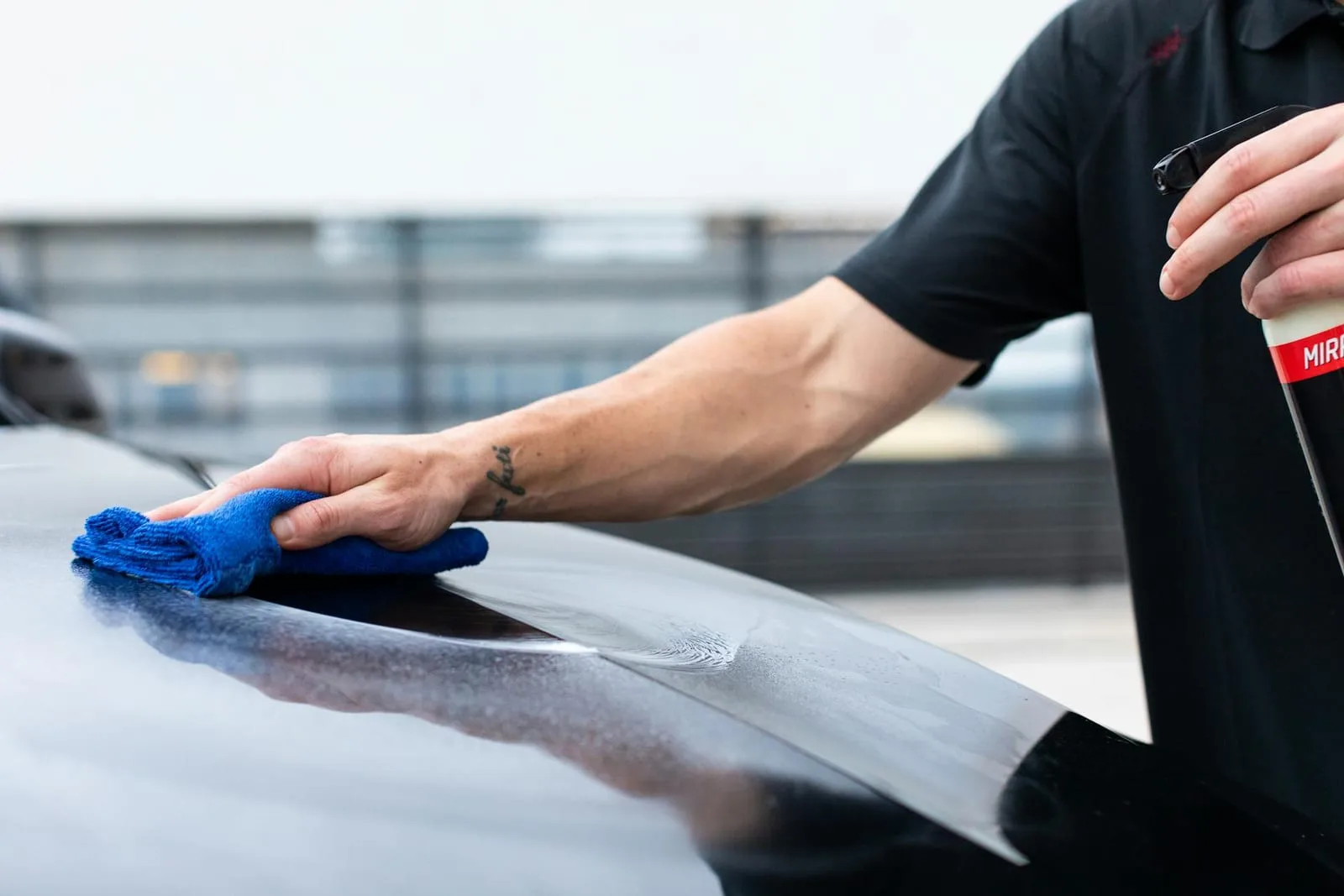
Quick comparison: ceramic coating vs paint sealant
| Feature | Paint Sealant | Ceramic Coating |
|---|---|---|
| Bond type | Sits on clear coat | Chemically bonds with clear coat |
| Durability | 6–12 months | 2–5 years |
| UV protection | Moderate | Excellent |
| Hydrophobic effect | Yes (temporary) | Yes (long-lasting) |
| Scratch resistance | None | Light scratch resistance |
| Application | DIY possible | Professional shop required |
| Miami climate lifespan | 4–8 months typical | 2–4 years typical |
| Cost (market range) | Lower | Higher |
Paint sealant: what it is and how it performs
Paint sealant is a synthetic polymer product — typically polysiloxane or polytetrafluoroethylene-based — that creates a protective layer over clear coat. It's applied like a wax, cures to a hard shell, and provides UV protection, water repellency, and minor contamination resistance.
What paint sealant does well:
- Quick to apply — 1–2 hours for a full car
- Adds noticeable gloss immediately after application
- Protects against bird droppings, tree sap, and rain water spots short-term
- DIY-friendly — no special equipment required
- Good choice for vehicles with recent paint damage (sealant over compromised clear coat is fine; ceramic requires fully corrected paint)
Where paint sealant falls short in Miami:
- UV breakdown accelerates in Miami's UV 9–11 index — a sealant rated for 12 months in Ohio lasts 4–8 months here
- Heat cycling (paint heating to 140–160°F in parked Miami cars) degrades polymer bonds faster
- Requires reapplication every 6 months to maintain protection
- No meaningful scratch resistance — any contact scratches through to clear coat
Ceramic coating: what it is and how it performs
Ceramic coating (also called nano-ceramic coating or SiO2 coating) uses silicon dioxide nano-particles that chemically react with the clear coat surface during curing. This creates a semi-permanent, glass-like layer that is harder than the clear coat itself.
What ceramic coating does well:
- UV resistance: blocks UV penetration to the clear coat for 2–5 years
- Hydrophobic effect: water beads and rolls off paint, carrying contaminants with it
- Chemical resistance: protects against bird droppings, tree sap, industrial fallout, and road chemicals that etch clear coat
- Scratch resistance: adds measurable surface hardness — reduces light swirl marks from improper washing
- Oxidation prevention: critical for Miami paint that would otherwise oxidize within 2–3 years of UV exposure
Where ceramic coating falls short:
- Cannot be DIY-applied correctly — humidity, temperature, and surface prep are critical
- Requires fully corrected, contamination-free paint as a base — applying ceramic over swirls locks them in
- More expensive than sealant upfront (though cheaper per year than annual sealant reapplication)
- Does not prevent rock chips or deep scratches — that's PPF's job
Which protection wins in Miami's conditions
Miami presents the most demanding environment for paint protection products in the continental US. The combination of factors accelerates degradation of any protective layer faster than in most other climates.
Miami's paint enemies:
- UV Index 9–11 daily — highest in the continental US, year-round. Every day of parking outdoors without UV protection is cumulative damage.
- Surface temps 140–160°F — clear coat softens at sustained high temps, making it more vulnerable to contaminants and more likely to absorb pollutants
- Salt air — coastal exposure throughout Miami-Dade deposits salt on paint surfaces that bonds with clear coat over time
- Daily rain + sun cycles — water evaporates leaving mineral deposits; the wet-dry cycle repeated 300+ days per year creates persistent water spotting
Performance under Miami conditions:
Paint sealant breaks down from UV and heat over 4–8 months in typical Miami outdoor parking. Once it degrades, the bare clear coat is exposed. A car parked outdoors in Doral or Homestead without protection will show oxidation and UV haze within 2–3 years.
Ceramic coating maintains its UV-blocking and hydrophobic properties for 2–4 years under the same Miami conditions. The chemical bond is not degraded by heat or UV the way polymer sealants are. The hydrophobic effect means contaminants don't bond with the paint surface — they roll off when it rains or when you rinse the car.
Application requirements: why ceramic can't be done mobile
This is the most important practical distinction for Miami drivers researching ceramic coating.
Paint sealant can be applied outdoors, in a garage, or even in direct sun (not recommended but possible). The polymer simply needs to be applied to clean paint and allowed to cure.
Ceramic coating has strict application requirements:
- Surface must be paint-corrected — ceramic locks in whatever surface condition exists. Swirl marks, water spots, and oxidation must be fully removed before application
- Paint must be decontaminated — iron contamination, tar, and bonded compounds must be removed with clay bar and chemical decontamination
- Humidity must be controlled — high humidity during application causes the coating to cure improperly, creating high spots and uneven hydrophobic performance
- Temperature must be controlled — too hot or too cold prevents proper chemical bonding
- Panel must be IPA-wiped — any oil, wax, or sealant residue on the surface prevents the ceramic from bonding
This is why mobile ceramic coating is not advisable in Miami — humidity, ambient dust, and uncontrolled temperatures make proper application nearly impossible outdoors in South Florida.
Which one should you choose?
Choose paint sealant if:
- You have a daily driver with imperfect paint you're not planning to correct
- Your vehicle is stored in a garage most of the time and UV exposure is limited
- You want temporary protection before a more permanent solution
- Budget is the primary constraint
Choose ceramic coating if:
- You park outdoors in Miami sun daily
- You own (not lease) your vehicle and plan to keep it 3+ years
- You've recently had paint correction done and want to protect that work
- You drive a luxury or high-value vehicle
- You want to minimize car washing effort — the hydrophobic effect makes maintenance much easier
Frequently asked questions
Is ceramic coating worth it in Miami? For most Miami drivers who park outdoors and own their vehicle, yes. Miami's UV index breaks down paint sealant in 4–8 months. Ceramic coating provides 2–4 years of protection under the same conditions. For a vehicle you plan to keep, ceramic is cheaper per year than annual sealant reapplication — plus it protects the paint from the oxidation that otherwise happens within 2–3 years.
Can ceramic coating be applied to a car in Miami's humidity? Not outdoors. Ceramic coating requires humidity-controlled and temperature-controlled conditions. High ambient humidity during application causes uneven cure, high spots, and poor adhesion. Professional shops apply ceramic in climate-controlled bays. This is why mobile ceramic coating is not advisable in South Florida.
How long does paint sealant last in Miami? Paint sealant typically lasts 4–8 months in Miami-Dade conditions — less than its rated lifespan in northern climates because of Miami's UV and heat. Reapplication twice a year is needed to maintain consistent protection.
Do I need paint correction before ceramic coating? Yes — ceramic coating should only be applied to fully corrected, decontaminated paint. The coating seals in the surface condition as-applied. If swirl marks, water spots, or oxidation are present, they'll be locked under the ceramic layer. See our paint correction guide for more.
Can ceramic coating go over paint sealant? No — the paint surface must be completely free of sealant, wax, and oils before ceramic application. Any residue prevents the nano-ceramic particles from bonding with the clear coat. Paint must be decontaminated and IPA-wiped before application.
Related: Car Detailing Miami · Paint Correction Miami · Paint Protection Film Miami · Car Detailing Cost Miami