Plain-language notes on every item in the work list — what it is, why it is done, and what to know before doing the same on your car.
Vinyl wrap
A vinyl wrap changes a car's color or adds graphics without repainting. Brand demo cars use it to carry the manufacturer's colors, and it can be removed later; while it's on, it shields the paint underneath from sun and light scratches. Quality comes down to surface prep, clean edges and seams, and post-heating the film so it holds its shape in the Miami heat.
Car wraps in Miami → Lifted suspension
A lift raises the body or suspension to clear bigger tires and gain ground clearance off-road. A proper lift is more than taller springs: shocks, steering geometry and driveline angles have to work at the new height, and the vehicle needs an alignment afterwards — skipping it wears tires out fast. On a Jeep it is also what makes room for larger wheel-and-tire packages.
Lift kits & suspension → Custom and aftermarket wheels
Wheels set the stance of a build as much as paint or a wrap does. Choosing them is about more than style: diameter, width and offset decide whether the wheel clears the brakes and suspension and sits correctly in the fender, and the overall tire diameter affects speedometer accuracy. New wheels should be mounted and balanced properly, followed by an alignment check.
Tires & custom wheels → Roll cage
On an open-top vehicle like a Wrangler, the roll cage is both a safety structure and prime mounting space. With no fixed roof, it is where overhead speaker pods, lights and grab handles commonly go. Anything mounted to it should clamp on rather than be drilled into the structure, and wiring has to be routed and sealed so it survives sun, rain and washing — audio in a Jeep has to be built for the weather.
Custom subwoofer enclosures
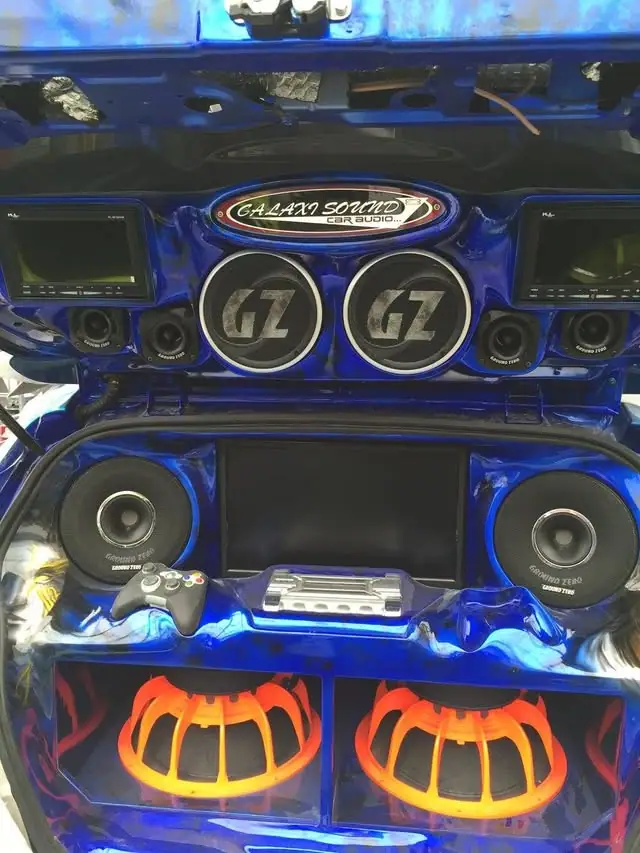
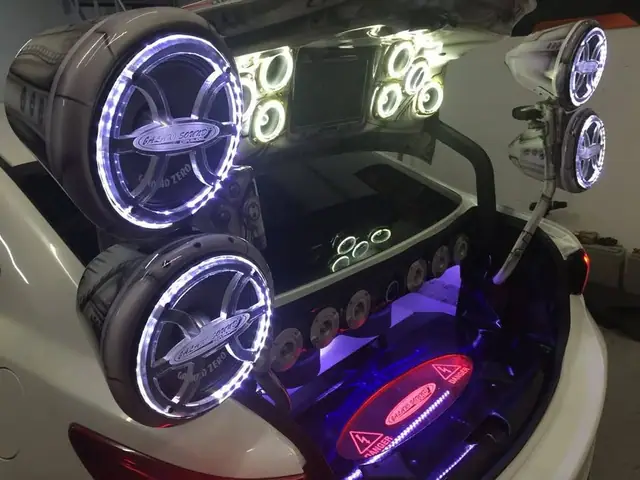
A subwoofer only performs as well as the box it's in. A custom enclosure is built to the internal volume the driver needs, then shaped to the space the car actually has — trunk floor, side walls, rear deck or cabin. Fiberglass lets the box follow curves no flat MDF panel can, which is why show builds lean on it. On a daily driver the same skills can go the other way: a stealth box that hides the sub and keeps the trunk usable.
Subwoofer & enclosure installs → Subwoofers
Subwoofers reproduce the lowest notes — generally below about 80–100 Hz, where regular door speakers can't move enough air. Running several subs, as show and SPL cars often do, raises output, but each one also needs amplifier power, enclosure volume and electrical capacity to match. For most daily drivers, one or two well-chosen subs in the right enclosure give deep, clean bass without giving up the trunk.
How to choose a car audio system → Amplifiers and amp racks
Amplifiers turn the small signal from the head unit into the power speakers and subwoofers need. A mono amplifier usually drives the subs, while a multi-channel amp powers the door and dash speakers. In a trunk install or amp rack, placement matters: amps need airflow to stay cool, a solid mount, short and properly fused power runs, and gains set with a meter so the speakers get clean power instead of distortion.
Amplifier installation → Custom door panels
Factory doors are designed around small speakers and thin plastic trim. A custom door panel gives larger or additional speakers a rigid, sealed mounting surface, aims them better and turns the door into a design element with its own colors, trim rings or lighting. Done right, the panel still clears the window mechanism, handle and lock, and it stays solid and rattle-free after years of opening and closing.
Speaker & door panel installs →